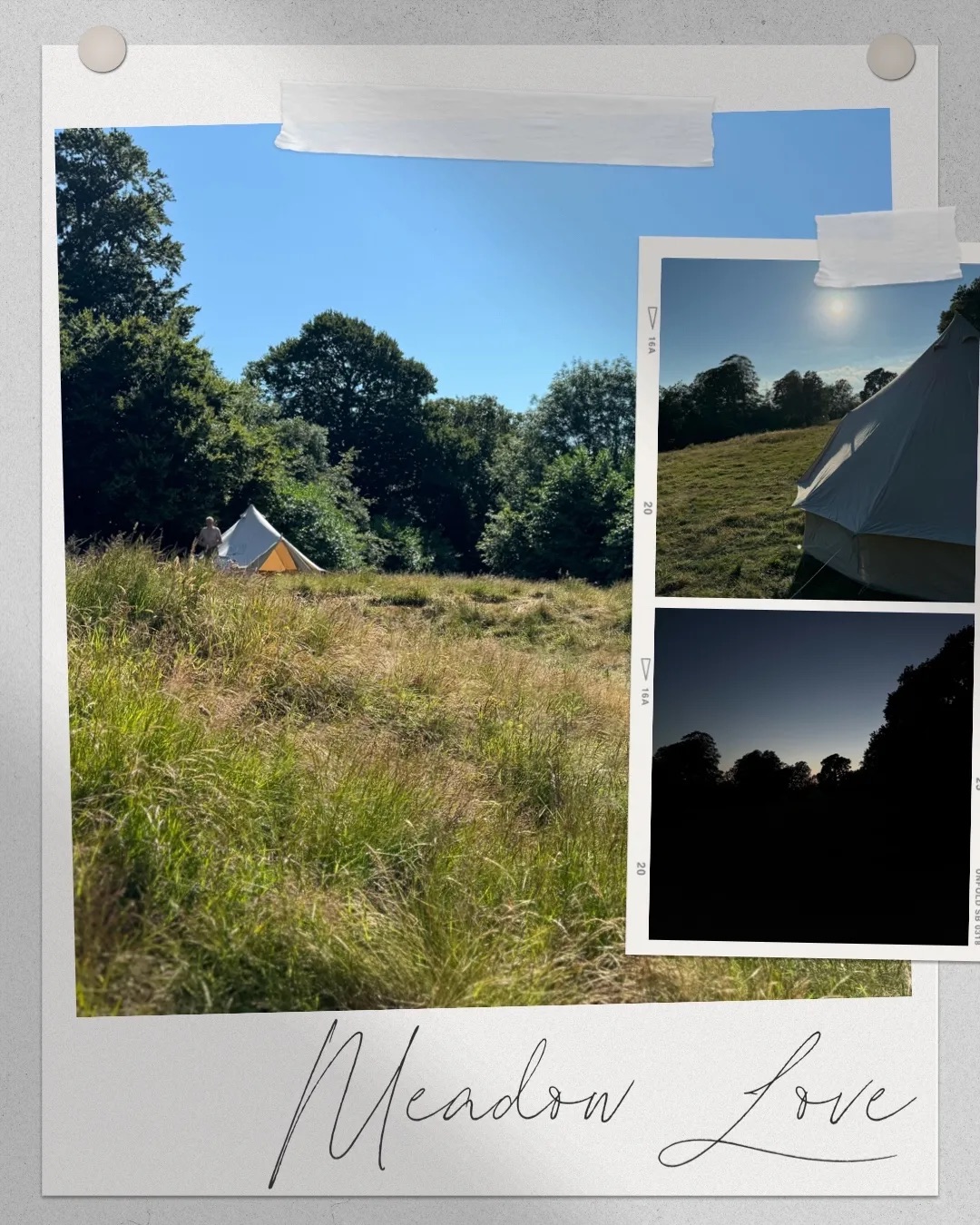
September 2020. We've pitched our tent in a Dorset meadow. M's brother has died alone in his flat. Somewhere between grief and paying close attention, the archive begins.
We’re in Dorset to see M’s family, his mother, an octogenarian who lives independently, his sisters and their families. There has been a lengthy enquiry because M’s older brother has died, but the time or cause of his death can’t be determined. There’s no pathology. All we know is that he must’ve died in August. Because of lockdown, and because he lived alone, nobody had missed this kind and clever man, who liked to fix bicycles and motorbikes, who collected timepieces, and paraphernalia from army and navy stores. His landlord found him lying on the floor of his flat. He was sixty two.
*
Friday morning September 10. At first light, I’d the sputtering, waking dream hallucinations you sometimes get between sleep and full consciousness. A young girl in tomato red pyjamas tugs the zip’s pull, making sure the tent is closed, in case the snake returns. It’s because we’re camping I’ve had this dream again. This is the memory which triggered the dream:
We were in France. Mum had asked me to empty the teapot in the field behind the tent. I didn’t see the snake until it whipped the ground. Leaning back, as if to strike, it put its tail in its mouth and wheeled away.
“Like a bicycle wheel, and as fast as you like,” I’d said to my grandfather after that holiday, knowing he alone would keep my secret. I must’ve been nearly eight years old because Grandpa died the following year, and the winter after that, my parents separated and put our house on the market. [1]
“Whiplash snakes …. Move by you like a press train,” said Romany gypsy Freda Black. That was in 2012. I was on the web listening to Freda describing her experiences of snakes that “moved in cartwheels” to her friend, singer and folk song interpreter, Sam Lee.
I’d first heard Sam, with cellist Francesca Ter-Berg, perform at a social enterprise unconference [2] in London. Soon after, Sam’s debut album Ground of its Own got nominated for the Mercury Music Prize. By this time, I’d got into the stories behind the age-old songs he collected, and invited Sam and his band to play in Cumbria. Freda’s story made my heart hammer, triggering memories of what my maternal grandmother, Amy, had told me one summer.
That summer, I’d gone to Sussex to stay with Amy and her husband Horatio for the duration of the school holidays. Long divorced from my grandfather, and on her third or fourth marriage, my grandmother, with her two-headed fox furs and heavy gold jewellery, frightened and fascinated me in equal measure.
“What do you enjoy doing?” she said, while pouring coffee. “Do you take cream?”
“I’m not allowed coffee. I enjoy reading and gardening.”
I spent a lot of time in Grandma and Horatio’s garden, making a den, lavender bags, rosewater... There was a boarded-up house next door with roses growing through the trees, and an air raid shelter. Horatio told me the house had been empty for years. I could explore, if I liked.
Horatio was interesting to talk to. He told me that technology was moving fast. “One day,” he said, “when you pick up a telephone, there’ll be a direct line to Saint Peter.”
“Come and see what I’m up to,” said Horatio, one afternoon. Stepping into his shed, I examined Horatio’s collection of preserved bumblebees, beetles, speckled crickets, dragonflies, mayflies. He’d made scaled-up and motorised cars, buses and motorbikes with sidecars for the insects, and talked me through the process. Enchanted by this curious entomological sideshow, I told Grandma and Horatio I’d once seen a snake put its tail in its mouth and wheel away. I suppose I was too young to grasp that my grandmother had a reputation in our family as a fabulist and a spieler with a story for every occasion. But I remember what she said next, looking into my eyes while leaning into the table.
“Only gypsies see cartwheel snakes.”
At that moment, Grandma’s dress disappeared into the chintz wallpaper and soft furnishings. What remained, as if hovering over the table, was her powdered face, her dark eyes, white hair. Bright coloured lipstick gathered in the cracks of her lips. I remember how her breath forever smelt of coffee and chocolate mints.
“Only gypsies,” she said again, as if this would mean something to me. “Close your mouth, you look like a goldfish.”
*
I’ve stepped from under canvas into the day, wriggled my feet in the grass. At this early hour, I can taste the heft of the air and pay close attention. Woodland all around crackles like static, a buzzard mews overhead. There’s distant traffic hum from the trunk road that runs all the way from Guildford to Bere Regis. We’re about six miles from the sea as the crow flies, pitched at the eastern boundary of a long meadow, a grassy terrace underlaid with plateau gravel. As ever, I’m compelled to imagine the landscape across epochs of time.
This is a back-to-basics campsite. There are no electric hookups, or caravans, or motorhomes. Our host, David, transports camping gear up a steep wooded incline to the meadow in his pickup. All other vehicles remain in a small car park. The narrow road below winds through centuries old linear settlements. Across the road, in the valley beyond the ancient hedgerows, and the brick and flint cottages with thatched roofs, a river meanders through copses of trees, oozy meads and pasture.
Given the woodland, and the sensitive approach in which David cares for this place, it must be a habitat for hundreds of lifeforms. There are glow-worms, meadow grasshoppers, the only species of grasshopper that can’t fly because of their stunted wings, rare bats, deer. Yesterday, come dusk, we saw a buzzard and red kite sharing airspace while migrant and brown hawker dragonflies searched for prey just metres away from our pitch. Across the lane, on the banks of the Stour we've seen banded demoiselles and black-tailed skimmers. I’m picturing a prehistoric dragonfly with a wingspan of a buzzard or raven. I’ve experienced intense thoughts and vivid imagery about geological time and primaeval creatures for as long as I can remember. It’s a kind of grounding and a solace, I suppose. It blows my mind to think that just fifty miles from here the bedrock is Early Jurassic, formed around 140 million years earlier than the ground beneath my feet.
Peeping inside our tent, I can see M is asleep. Alfie is eager to join me. All the same, he doesn’t object when I draw the zip and head towards the woodland, to one of the old bumper-pull horse trailers converted into a composting loo. Along the way, flattened lime green shapes on the meadow bear testament to the hither and dither of a holiday season now drawing to a close. Last night, it was dark by nine thirty. We’d lit a fire by then, and enjoyed seeing everyone else’s dotted around. A few family-sized inflatable tents shone electric blue, green, red. Another bell tent like ours; a canvas tipi and three permanent yurts at the western end of the meadow were lit up by solar festoons. Everywhere, shiny tech, faux industrial and vintage-inspired. Like a festival, we’d agreed, drinking in the mellow tunes from our neighbour’s wireless speaker.
We’ve had some friendly conversations with other guests in this meadow, and in the orchard below with its bow-topped caravans and shepherd’s huts. I’ve cooed over a hand painted cocktail bar a couple from London brought along, and we’ve compared notes on portable, wood-fired pizza ovens. Unfamiliar as we are with the bells and whistles of glamping, after years of the most basic camping, some of our one-on-one talk revolves around examining our privilege. I think we’re learning to be less self-conscious, comfortable with what we enjoy. I make my way back to our tent, past spent braziers and fire bowls, past bunting and prayer flags. A woman in bright red trousers and a plum-purple top is doing the sun salutation.
A botanical artist, gardener, and author lives on the fringe of this campsite. L’s small garden wraps around her cottage. I wouldn’t dare to explore without an invitation, though cannot help but peek when passing. I see a bold, theatrical, artist’s garden; also a concentration of everything I’ve felt about gardens since way back that I didn’t have the words for then.
After listening, over and over to Freda Black’s words in 2012, I sifted through the archives for references to cartwheel snakes, cataloguing everything found so far. “The Hoop Snake,” writes a journalist for Gleanings in the Carmarthen Journal, January 1892, “is marvellous enough to have come out of a fairy story, but he lives on the earth …. By and by midsummer dries up the marshes and the woodland pools; the hill streams run low or fail altogether. Sportsmen or foresters begin to say apprehensively: Better be careful, time for hoop snakes to come whirling out of the water crazy mad.” [3]
“In this midsummer madness the creature curves itself till the horned tail rests just on the back of its head, and whirls out along country roads or open woodland …. the name hoop snake or cartwheel snake comes from its locomotion on these midsummer forages.”
Mature trees bound the north, east and west of the meadow. At the western boundary, there’s a network of woodland walks under great cathedrals of beech, Monterey pine, oak. The woodland floor is spongy with leaf mould, crunchy with mast, rutted with roots. A dense understory of cherry laurel alongside the pathways reminds me that the campsite was once part of a country house estate. The house survives, it’s offices now. I’ve been tracing the lives of the people who lived there, building a picture. Alfie and I venture on a longer walk, under a girthy oak: a majestic waymarker to the steep, tree-rutted path down to the road and river beyond.
I’m singing a mishmash version of On Yonder Hill. Unlike me, Sam Lee performs a beautiful, reverent interpretation of the song, but I’ve enjoyed rooting out others. George Hanna (who learnt it from his father Joe,) Kara O’Brien, Jenna Walker with David Cambridge. It’s an old song. In 1820, the illustrator, painter, and writer William Henry Pyne, writing as Ephraim Hardcastle, references the lyrics in the Literary Gazette. [4]
“It is possible,” writes Steve Roud in his book Folk Song in England, “that [Pyne] was remembering genuine incidents of childhood, which would still be 1770s onwards, and if these really were his mother’s songs (she died in 1819) it could be taken as an indication that they were in circulation before that time.”[5]
Dusk. I’ve been in the woodland with Alfie collecting pine cones for our fire, a primitive act that makes me feel insanely happy. M has gone to collect logs.
There’s a long tradition of Wicca, here in this woodland. Natural magic.
Is there an incantation that will ensure you a long, healthy life, Alfie, no matter what the vet said?
[1] I inherited the newspaper clipping along with other paperwork from my mother’s effects and transcribed it into my diary Ad Verbum:
“Considerably improved fully gas C. H. four bedroomed family house in quiet road close local shops. Spacious accomm. incl. entr. hall, two good recept. rms. (gas fires incl.) Huge fit. b’fast kit. Playroom with store and w.c. off. Four good bedrms. (one with h’basin, three with b-in robes.) Bathrm. with w.c. Integral bk. garage. Large rear gdn. and 2nd garage from private drive giving boat / caravan parking. Except. opportunity at realistic price. £11,450.”
[2] “During Global Entrepreneurship Week 2011, UnLtd hosted the SHINE Unconference at Hub Westminster. The event was all about joining the conversation and seizing opportunities to learn from each other.” Online at https://www.unltd.org.uk/; date accessed Monday 26 February 2024
[3] The Hoop Snake. Carmarthen Journal Friday January 1, 1892 Online at https://www.britishnewspaperarchive.co.uk/; date accessed Sunday 13 October 2019
[4] “The source of Jim Dixon's quote in the London Literary Gazette was William Henry Pyne (1769-1843), writing as Ephraim Hardcastle "a Cockney Greybeard". Pyne was a water colourist who took to writing a series of reminiscences and after dinner gossip in the Gazette, later published in book form as Wine and Walnuts 1823/1824. Steve Roud in Folk Song in England points out that there are reasons to doubt Pyne's veracity. Pyne/Hardcastle claimed however that his mother, Mary Craze, had sung the song to him in his childhood, having learned it in her childhood in the hamlet of Holcombe Rogus, near Tiverton in Devon, so that possibly the original song might be a Devon hunting song of the mid-18th century.” (Matthew Edwards on a thread on mudcat.org) Online at: https://mudcat.org/thread.cfm?threadid=104277; date accessed Monday 26 February 2024
[5] Roud, Steve. Folk Song in England (p. 281). Faber & Faber. Kindle Edition.