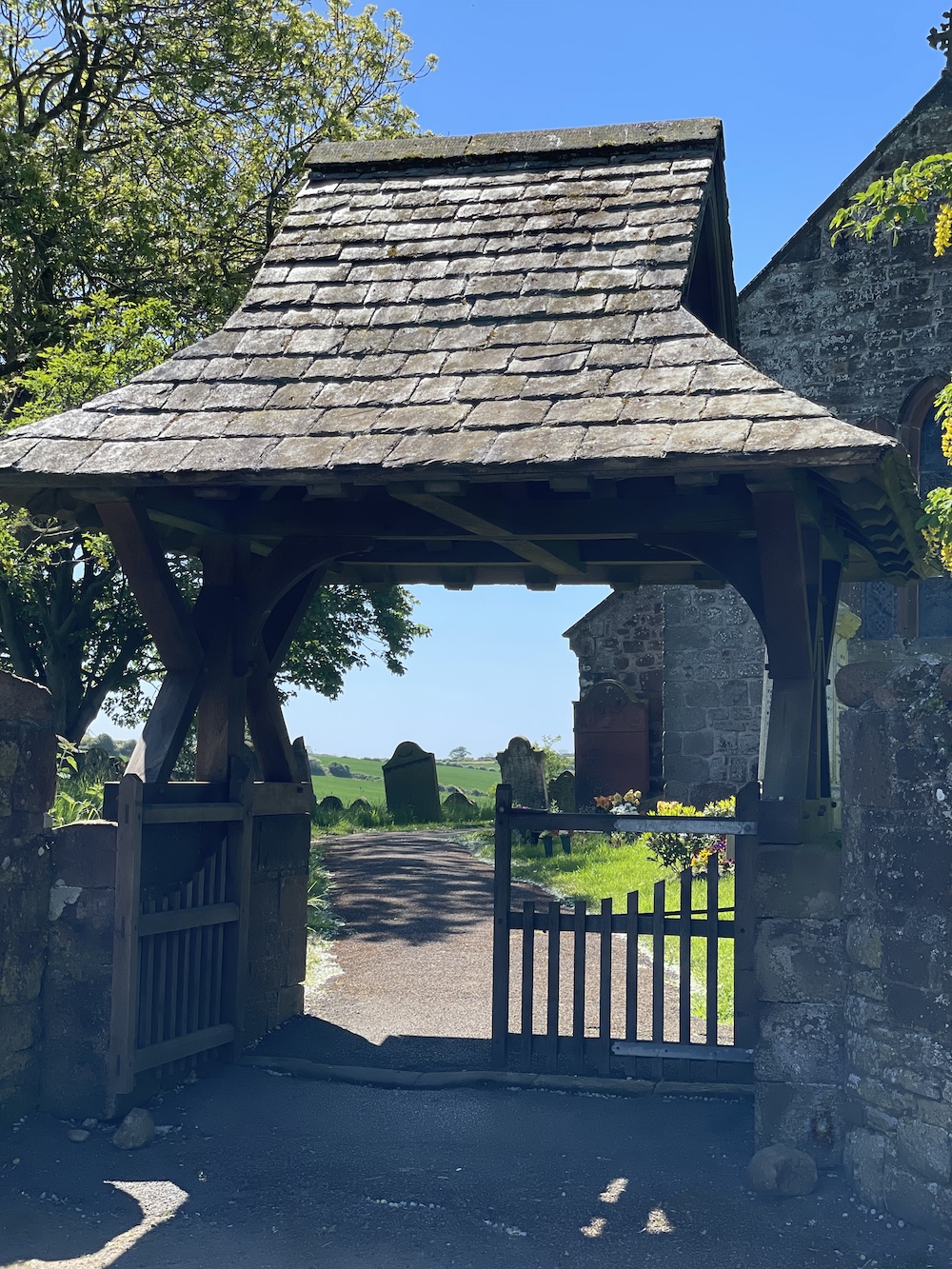
Here is a peek of the Wesleyan Chapel (now a private residence) in Gilcrux.

Image: Bee Lilyjones
ISABEL SANDERSON and the Reverend Richard Simpson Watson were the first people to be married at the methodist chapel on Wednesday August 8, 1894.
According to one newspaper, Isabel and Richard's wedding breakfast was next door to the chapel, at Retreat, which Farm, which Isabel’s father, Mark, farmed with his sons, Mark and James.” But in another newspaper ...
MARRIAGE AT GILCRUX
Yesterday (Wednesday) Gilcrux was en fete, the occasion being the marringe of a highly respected resident of the village Isabella Sanderson, only daughter of Mr. Mark Sanderson of Grange Farm. The bridegroom the Rev. Thomas Richard Watson, of Rochdale, Lancashire, a native of Gilcrux, and son of Mrs. Watson, a most highly respected resident in the parish. The happy ceremony took place at noon, and was celebrated in the little Methodist Chapel in the village, which only a fortnight ago was registered for the solemnisation of marriages, and the interesting event of yesterday was the first marriage within the precincts of the sacred edifice at. Gilcrux. A large concourse of friends turned in to witness the ceremony, and the bridal party had a most happy reception. The bride was given away by her father. On leaving the chapel the party were well scattered with rice, and met with the usual hearty congratulations for their happy union and future health and happiness. Mr. and Mrs. Watson subsequently had refreshments with their many friends at Grange Farm, and in the course of the afternoon left to spend their honeymoon in the South. The presents were many and valuable.
What drew me to Mark Sanderson's story was a question we’ve all asked when passing a derelict dwelling. What happened there? Who lived there?

Aurora Borealis over Retreat Farm. Thursday October 10, 2024. Image: Bee Lilyjones
Mark Sanderson was born on Christmas Day, 1835.
The 1841 census records Mark as a six-year-old living on Challoner Street in Cockermouth.

"Inside one of those cottages, Mark’s widowed mother, Dinah, faced a cold arithmetic. The same census that placed one of her sons in work recorded her as pauper."
Walking along Challoner Street today, I am all but a few minutes walk from the Cockermouth Castle Mark would have known, its ruins rising above the town. And climbing Kirkgate (“church street”) halfway up the hill is All Saints, where Mark’s parents, Richard and Dinah, had him christened in January 1836. Georgian terraces from the 1720s line the cobbled street of Kirkgate, protected as listed buildings these days, trees shading the way.

"After standing empty for decades, Wyndham renovated parts of the medieval structure in the early 1800s

"Georgian terraces from the 1720s line the
cobbled street of Kirkgate, protected as listed buildings these days, trees shading the way."
The population of Cockermouth back in Mark Sanderson's day would have been around four-thousand-seven-hundred, today it’s close to nine-thousand.
George Wyndham, 3rd Earl of Egremont’s audit at Cockermouth Castle in December 1835 represented just one corner of vast holdings that reached from Cumberland to Sussex. The castle had reached the Wyndham family through the Percy inheritance. When the direct Percy line ended in 1670, the estates passed through the Seymour dukes to Charles Wyndham in 1750, who received both the property and the Egremont title. After standing empty for decades, Wyndham renovated parts of the medieval structure in the early 1800s as summer accommodation. The current Lord and Lady Egremont continue to use the castle as summer accommodation and live at Petworth House in Sussex.
Below the castle, Georgian stone houses line streets that still follow their medieval patterns. Their residents lived within industries the Earl’s family both shaped and profited from. The Rivers Cocker and Derwent meet in Cockermouth. Their water powered mills and factories, feeding an economy that shifted fast. In 1835, the Main Street hiring fairs drew the crowds, where farm labourers sought work.
Public houses on every corner served the men who came to trade their labour. This was the world that men like Williamson Peile could survey from above. Three years before Mark’s birth, Peile had soared in a balloon over Cockermouth, writing rapturously of the “white vapour rising into still air” above the town.
Peile and the Earl represented different scales of the same power structure. Peile was a colliery owner leasing mining rights in our village, representing the industrial power that would employ Mark before he found his own path to become a substantial farmer in his own right.
The Earl welcomed J.M.W. Turner into his home at Petworth House, funding canals and agricultural experiments with one hand while organising the systematic removal of surplus rural workers to Canada with the other. The Petworth Emigration Scheme shipped thousands to Upper Canada during these years. It revealed how men of such wealth managed the ‘problem’ of rural poverty. Not by changing conditions at home, but by moving the poor elsewhere. Mark was born into this world of casual employment and casual drinking, christened into the established church that blessed castle and commerce.
Mark’s father, Richard, died at home on Challoner Street in 1849, of a stomach stricture. Mark was thirteen. By the age of fifteen, Mark is living and working at nearby Wellington Farm. Lodged and earning, his footing in the adult world beginning to hold.
Back on Challoner Street, the dwellings stood close, their painted fronts faded where landlords saw no profit in fresh limewash. Inside, walls ran damp to the touch, the plaster cold and darkened in corners where daylight never reached. The street itself bore the residue of coal fires and factory smoke, ash settled in every crevice, soot-stained rain finding its way between stone flags and thresholds. Inside one of those cottages, Mark’s widowed mother, Dinah, faced a cold arithmetic. The same census that placed one of her sons in work recorded her as pauper. Four children remained under her roof: John, now seventeen and apprenticed as a whitesmith; thirteen-year- old Jane; eleven-year-old Thomas; and Dinah, the youngest, just eight. As for Joseph, the oldest, he’d moved away from home, and I’m still looking for him.
Pauper. The word meant more than hardship. Since the Poor Law Amendment Act of 1834, only those officially classed as destitute could qualify for relief. It wasn’t enough to be poor; you had to prove dependence. Relief for widows with young children came as a small weekly payment, two or three shillings, say, or in-kind support: coal, bread, secondhand clothing for the children. The Board of Guardians in Cockermouth recorded such grants in its minute books, every item measured and approved. Here were the harsh realities that must have helped shape Mark’s later convictions. He knew poverty, had witnessed how a family could fragment. And there was a drunken brawl on the streets of Cockermouth most days.
On Thursday, June 12 in 1851, the town was organising the rebuilding of All Saints, the church where Mark’s parents had him christened in January 1836. Fire had destroyed much of the building in 1850, leaving only the medieval tower standing. Now ratepayers were being asked to fund its reconstruction through subscription or, failing that, through a compulsory rate. Mr Tyson spoke at the vestry meeting to argue that they all regretted the destruction of their church, but if they didn’t rebuild it soon, by subscription or rate, the Consistory Court would compel them to take steps which every rate-payer would regret. Even in ruins, the established church could exercise its legal teeth to compel payment - from Methodists and Quakers alike, even.
Mark was not alone in turning towards dissent. Ten miles away in Boltongate, another family was discovering similar solace. Jane Simpson was born the same year as Mark, 1835, daughter of a coal miner. Like Mark, Jane knew the precarious nature of industrial life in Cumberland. When Jane married Richard, a man who had moved from farm servant to coal miner, that common transition from field to pit, they would find their anchor in Methodist conviction. They lived in our village by then, where farmers and miners drank in the public houses, where there was often trouble. Three of Jane and Richard’s five children would become ministers, as if the family had collectively decided that faith offered the only reliable foundation.
In 1866, Mark took up an apprenticeship as a smith with the Maryport and Carlisle Railway.
“In 1857 the company took to building its own engines at Maryport …. In 1859 Tosh stated that ten had been adapted to burn coal instead of coke, which made a considerable reduction in running costs. The company’s engines were fitted with steel tires as early as 1862; and the very first steel locomotive boilers were made for the Maryport and Carlisle and the London and North Western railways in 1862 and 1863. We have seen besides that the Maryport and Carlisle made experimental use of steel rails in 1867. It is appropriate that the company should have been, in a modest way, a pioneer in the use of steel, since West Cumberland made so vital a contribution to the success of Bessemer’s process.”4
Mark’s new life as a smith required documentation. William Irvine, a draper who had known Mark all his life, made a formal declaration of his age. (5)

Mark’s new life as a smith required documentation. William Irvine, a draper who had known Mark all his life, made a formal declaration of his age.
Sanderson, M. (b. 1835)
The locomotive superintendent was a Scot named George Tosh, a pioneer. He’d been in post since 1854, already transforming how the company built and maintained its rolling stock. Tosh was about forty-four years old when Mark arrived. The chairman6 would later praise him as “a most valuable servant of the company, who worked day and night and kept his department in excellent order.”
I try to imagine how the building announced itself to Mark each morning. Iron and noise where there had been quiet in the fields. The ring of hammers on metal carrying across Maryport at dawn. And the heat. Smiths shaped brake systems and boiler parts over forges that burned coal now, not coke. Another of Tosh’s innovations. The forges burned hotter, the work went faster, the air in the shops grew thick with a different quality of smoke.
The wages exceeded what rural labour could offer as a farm servant at Wellington Farm. I know from Mark’s obituary7 he had started work as a smith at the railway on seventeen shillings a week. Instead of scraping by, here he was building something. No longer a farm labourer at hiring fairs but on the way to being a craftsman with a trade that belonged to him.
Mark was driven, aspirational, and must have been able to feel it in the town. Money moving. Confidence building. He was learning at the cutting edge of British engineering. Did he have a sense he was standing in the middle of history being made?
George Tosh was pushing the boundaries of what was possible. Mark worked in smith shops where the air smelled of hot metal and coal smoke and the oil used to cool the tools. Where the floor was dark with iron filings and scale. Men shouted to be heard over the hammering and the hiss of steam and the clang of metal on metal. And yet, early on, I think Mark must have known this was not the life he wanted. It wasn’t the hard work he minded. I believe Mark had his father’s animal husbandry in his genes, he missed the open countryside, he missed everything about horses. He began to dream and save.
Mark boarded, at this time, in Maryport with Mrs Jane Quay, widow of William, a seaman who had died of a stroke three years earlier. Did Mrs Quay and her grown daughters worship at the Scottish Presbyterian church? Mrs Quay had been christened there all those years earlier. That church stood outside the established Anglican fold, maintaining the Calvinist theology and Presbyterian structure of the ‘Kirk’ across the border. Maryport from the late 1850s was a town of dissent. At least six nonconformist congregations had taken root there. The Scots Presbyterian chapel. The United Presbyterian chapel. The Quaker meeting house. The Wesleyan Methodist chapel. The Primitive Methodist chapel. The Baptist chapel.8 For a port town, this was a striking concentration of dissenting worship. Why was that?
Church congregations were navigating a period of change. Some were thriving through strong cross-border family ties and the patronage of merchants and master mariners like William Quay had been. What these churches offered was a different community. One organised through presbyteries rather than bishops. Emphasising education and literacy. Running schools where Anglican provisions fell short.
Mrs Quay’s house was full. There was Mark and another lodger, James the mariner, Mrs Quay’s two-year-old grandson, one of her daughters, Eleanor (another daughter, Ann Mason, lived in service) and Eleanor’s grocer husband. Whatever quiet had followed William’s death had long since filled with voices and footsteps. Mrs Quay had transformed grief into practical management. Mark returned to Mrs Quay’s house each evening. Soot in his hair, hands blackened despite washing, clothes smelling of the forge. Did he talk about his day? About what he was learning? Or did he simply eat, wash, and fall into bed, too tired for conversation?
The works in Maryport would continue building locomotives until 1895. After that, they’d be used only for rebuilding and repair. When the London Midland and Scottish Railway took over in 1923, they shut the Maryport carriage, waggon and locomotive shops at the end of February 1924. It had been described as “one of the industrial mainstays of the town.” By 1931, unemployment in Maryport reached 77 per cent.9 [Also see Footnote 4.] But that was all to come. In 1866, there was only the work. Noise. Heat. Learning. Mark would remember his apprenticeship at the railway in Maryport for the rest of his life, I know that from reading his obituary. He would have had an understanding that innovation and tradition were partners in the work of making things that mattered. He would carry this lesson to the land, to a farm - he didn’t know where just yet - where innovation and tradition worked together.
Sunday June 23, 1861. Mark married Jane’s daughter Ann Mason at Crosscanonby Church. If Mark and Ann were coming from Maryport, they would have driven the three miles along the coast road, the Solway Firth on their left. I often try to picture their day when I’m on that road. June weather here in West Cumbria is rarely settled. Sun one moment, cloud the next, light shifting across the estuary, water sometimes silver sometimes gold. The sea is visible most of the way, even now, glimpsed over modern rooftops and hedgerows and rises in the land. Crosscanonby lies inland, about three-quarters of a mile from the road, set back into a wedge of ground between fields.
When Mark and Ann stood in this church in 1861, they entered a building layered with centuries. The present structure dates from 1130, with a south aisle added in the 13th century. The chancel arch is Roman, brought from Maryport fort, possibly from the commandant’s entrance, with niches that once held statues. Light enters through Norman windows dating to around 1120.10 Outside against the south wall lies a Norse hogback gravestone from the 9th or 10th century, its ridge carved like a shingled roof. During the 1880 restoration, several sculptured stones were discovered built into the church fabric.11 In the porch lies the St Lawrence Slab, carved with a figure and gridiron symbol, traditionally dated to the 6th century.
The name Crosscanonby derives from Old Norse ‘krossa býr’, meaning ‘village marked by crosses’. 12 The site marked sacred ground long before this nave. On that June day in 1861, Mark and Ann added their names to the long record, joining their lives in a space shaped and shared by many cultures.
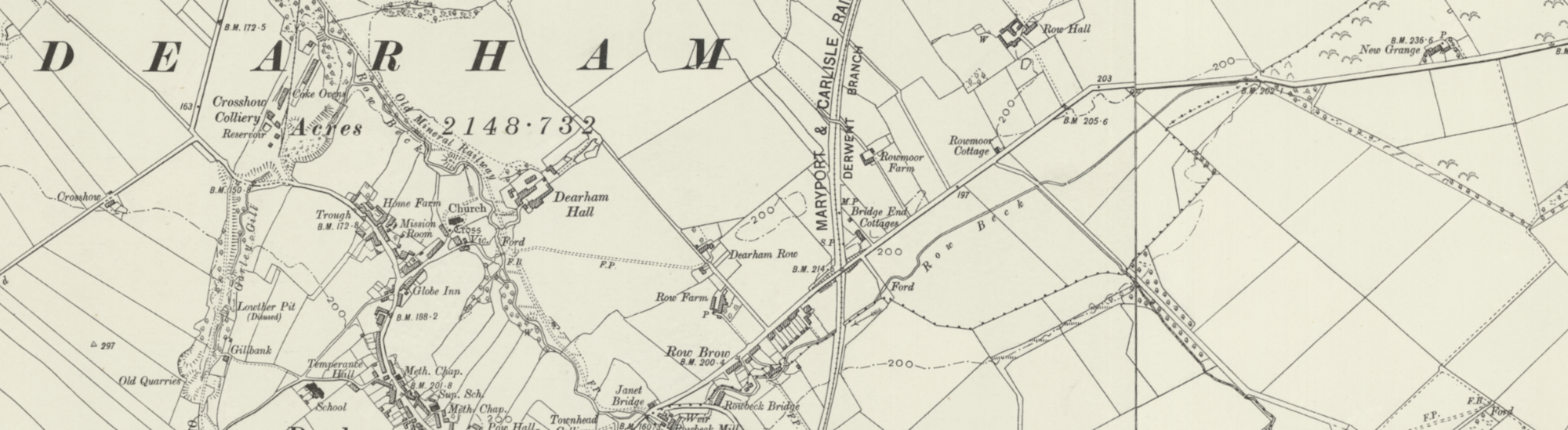
In the 1860s Mark and Ann had moved but a few miles from Maryport to Row Moor13 in Dearham, farming fifteen acres. John was born in early 1863, Isabel in April 1865, Mark in the winter of 1867 and James in early 1870.
But 1870 brought tragedy to the other family whose story was weaving itself towards Mark’s. On Wednesday November 30, falling stone killed Jane Watson’s husband Richard at Crosby Colliery. At thirty-six, Jane found herself widowed with five children. A twelve-year-old daughter and four sons, the youngest barely a year old. The underground world that had drawn Richard from farm work to mining had claimed him. Jane, left to navigate the same sudden poverty that had scattered Mark’s family decades earlier.
Years passed. Both families endured, bound to the same landscape, the same weather, their paths edging closer as time moved through the fields around them. And then, on Tuesday December 17, 1878, at the age of fifteen, John died. “Typhoid Fever 36 days. Congestion of both lungs, 30 days …. Mark Sanderson, Father, Present at the Death. Row Moor, Dearham.”14
By the end of the twelfth century, two Cistercian abbeys held interests here in the village, Holm Cultram and Calder Abbey. Holm Cultram, founded in 1150 with Scottish royal backing, accumulated land across the region, though neither it nor Calder was ever especially wealthy. In the 1240s, William d’Orm d’Ireby - local landholder, rector of Gilcrux, and grandson of Gospatric of Workington - gave Holm Cultram his house in the village, with its gardens and orchards and, later, eleven acres of arable land.
The house, I think, and certainly part of that land, the charter says, lay “under the Tower of Laurence.”15 Nothing of it survives. Just a sloping field opposite the church, with three modern houses - M designed and planted the front and back garden of one of them - and one house is still under construction.
A grange wasn’t just a farm It was church land, a satellite, if you like, in an English abbey’s system. Lay brothers (perhaps living in the dwelling where the Tower of Laurence was) worked the land and the yield went back to the abbey. Wool, mostly. And maybe what we’d call saltmarsh lamb, today. The Cistercian monks were farmers before they were anything else. Reverend Price once said they were “the greatest producers of wool in the kingdom.” I picture white-robed monks combing fleeces, throwing them over the hedgerow to dry in the south westerly wind which lifts them like ghost pelts.
Grange Farm, a name that remains even now, sits at the end of a long private drive in the far east end of our parish. By 1881, Mark and his family had taken on the tenancy of The Grange under the estate of Sir Wilfrid Lawson who lived nearby at Brayton Hall, Aspatria. Lawson’s many speeches, and the social makeup of his electorate and supporters indicate he would have favoured granted tenancies to nonconformists, to Methodists like Mark, who he saw as the moral core of the countryside. [See Footnote 6.]
Sunday January 2, 1887. James had walked to chapel, it was his turn to get everything ready for divine service at six o’clock. Mark junior had took the horse and trap to visit his sweetheart. Mark was on the high ground at Moota checking sheep. In Grange farmhouse, Ann sat sewing in the eastern room, Isabel beside her. Fire lit. The day already closing in. Lamplight. Cloth in the hand. Needle passing back and forth. The tick of a clock and the smell of beeswax. And something else. First, the faintest change in the air. A stitch missed. A pause. Then the rise of it, a thick, wrong smell. Not the hearth. Not the stove. Something else. They were on their feet before they named it. Mark saw the smoke from the hill. A single column lifting into the gloaming. By the time he reached the yard, the fire had taken what it came for.
“I am very sorry for Mr Mark Sanderson of the Grange Farm, Gilcrux. On Sunday night last he lost a deal of his stock, including two horses, two dogs, and a bull, by a disastrous and mysterious fire, that is believed to have been caused wilfully by someone. Mark Sanderson is a very worthy man, and he has had to work hard and long for what he is possessed of. He will lose a deal by this fire, as he was only partly insured, and it is hard to lose in such a way. I know Mark Sanderson well, and knew “his mother before him,” as we say in Cumberland. Old Dinah Sanderson’s yeast was a well-known article in and around Cockermouth in my boyhood, and Tom Sanderson, Mark’s brother - was as well known as the town clock. Poor Tom was considerably “daft,” but very harmless, and deeply attached to his mother. At the old lady’s death Tom went to live with his brother, but he has now been dead some time. I sincerely hope that if the fire on Sunday night was caused by some evil-disposed person the long arm of the law may soon reach the person and teach him a lesson.”
I have driven down to Grange Farm once with Bert and once on my own now. Nothing in the yard says what happened there. No plaque. No scars. It’s just an ordinary working farm with a handsome Georgian house But I wanted to hold silence in that yard for the animals that died there, and I did. I pictured Mark watching smoke rise, the sick knowing in his stomach, Ann and Isabel in the yard, bare hands outstretched, knowing it was too late. That night must have lived inside Mark and his family for years. And still, they carried on.
But sometime in 1891 he left Grange Farm for The Retreat, the now abandoned farm and derelict house opposite our cottage.
Saturday May 14, 1892. (16) Mark’s oldest son is rolling a field with the iron drum, Jane Simpson Watson’s grandson, Richard, eight years old, running alongside. The boy is quick and full of questions. There’s a pause to check the harness. Then the boy was down. A sound like nothing. A cry. Caught, leg wedged between the drum and the frame. It is bad. From ankle to knee. Bone crushed. Dr Briggs comes. They lift Richard and carry him to surgery. Briggs works quickly. He takes the leg at the knee, packs carbolic gauze into the wound and the village holds its breath. Richard lived. And as I’ve mentioned already, in 1894, Mark and Ann’s daughter, Isabel, married Jane Simpson Watson’s son, the Rev. Richard William Watson, young Richard’s Uncle.
I think about this today as I wander across the road to Retreat Farm, wondering which field it was where young Richard fell off the drum, and wondering how much has changed in the layout of the fields over the past one hundred and thirty years. I wonder if Isabel and Richard’s wedding breakfast really was at Retreat Farm, or, as another newspaper reported, in the east of the parish at Grange Farm? It’s becoming clearer that Mark farmed both properties for a short time.
At Candlemas 1896, Mark and Ann, Mark junior and James moved to nearby Crosby, to a substantial farm owned by Richard Bowman Brockbank, “a much esteemed member of the Society of Friends.” And it was there that, on Friday September 18, 1896, Ann died at the age of sixty-seven from “chronic phthisis [tuberculosis] and exhaustion."
Twelve years earlier, Ann had nursed Ellen, their seventeen year-old niece, daughter of Mark’s sister Mary, who died from the same disease at Grange Farm. TB was common in Victorian Britain, and it’s possible that Ann contracted the infection in 1884, carried it silently for over a decade and then developed the active disease in her sixties when her immune system became more vulnerable.17
I went to Crosscanonby in May 2023 with my friend Bert. Ann’s funeral notice in September 1896 had been brief.
“Friends please accept this (the only) intimation.”18
A cortège set off after the day’s work was done, left the farm at three. Crosscanonby churchyard the destination. We walked through the lychgate intending to find her. The oldest part of churchyard was beautifully wild, thick with cow parsley. (In our village churchyard, a debate is unfolding - how much to mow, how wild to let things get. Biodiversity versus neat and tidy.) That May in Crosscanonby, many stones leant. Others had lost their inscriptions altogether. Bert and I walked the ground twice, took different routes. Here and there I crouched to check where the stone had sunk, traced shallow carving with my fingertips, unsure of letters. Looked again. Either Ann’s stone has worn too smooth to read, or it’s gone entirely. A grave unmarked now. Weather erases them before we do. To be continued.